Custom Software vs. SaaS: How to Choose as a Small Business
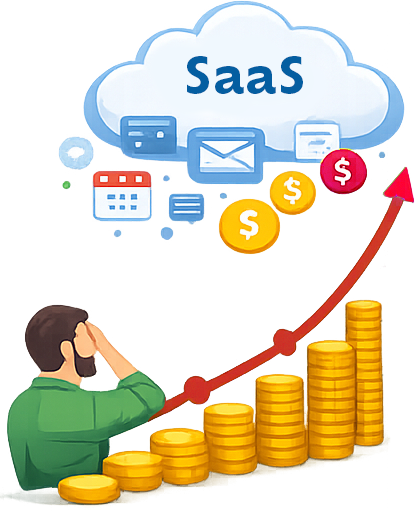
78% of SMEs use SaaS, but costs keep climbing year after year. When does custom software pay off more?
About 78% of companies invest in SaaS. Makes sense. It's fast, low barrier to entry, you're live tomorrow. But here's what a lot of business owners only notice after two or three years: that SaaS tool does 80% of what you need. Just not the last 20%. So you build an Excel workaround. Then add another small tool. And before long, your SaaS bill goes up every quarter.
Onoweb has been building custom software for Flemish SMEs for over 15 years. Many of our clients started with SaaS, hit a wall, and then moved to custom. If you're also wondering about why to have a website built — that's a separate topic. Here you get an honest comparison, with real numbers.
Quick comparison
| SaaS | Custom software | |
|---|---|---|
| Best for | Standard processes, startups, getting up and running quickly | Unique processes, complex integrations |
| Startup costs | Low (€50–500/month) | Higher (€5,000–30,000) |
| Cost after 5 years | €30,000–50,000 (subscriptions keep growing) | €15,000–35,000 (one-off + maintenance) |
| Flexibility | Limited — the vendor controls updates | Full control |
| Data ownership | You rent, vendor decides | You own everything, including the code |
| Scalability | Up to a point | Grows with your business |
| Implementation time | Days to weeks | 2–6 months |
| Dependency | High (price hikes, updates, shutdowns) | Low (you hold the code) |
What does SaaS actually cost after a few years?
Most SMEs look at their monthly subscription price and think: that's manageable. But add it all up.
You've got Teamleader for CRM, Exact Online for accounting, some ERP for inventory, Monday.com for project planning, maybe Mailchimp for newsletters and a scheduling tool for your field team. Each one €20–100 per month, depending on how many users. Sounds fine.
But it stacks up. An SME with five employees can easily hit €500–800 per month in SaaS subscriptions. That's €6,000–10,000 a year. Over three years: €18,000–30,000. And that's before counting the annual price increases almost every SaaS tool pushes through.
On top of that: you're often paying for more than you use. Licences for employees who rarely log in. Features you've never clicked. And the moment you want better reporting or API access, the price jumps again.
47% of organisations name vendor lock-in as a real problem. Want to migrate later? That costs time and money, and your data is stuck in the platform.
What does custom software actually cost?
Custom software sounds expensive, but the picture isn't always what people assume. A simple project — a client portal, an order tool with reporting, or a connection between two systems — can start from €5,000.
The big difference from SaaS: you pay once for the build, then a fixed amount for maintenance. No surprises, no annual price hikes, no extra costs when your team grows.
Compare that to three to five years of SaaS subscriptions, and the gap is often smaller than you'd expect.
When does SaaS make sense?
Honestly: SaaS isn't bad. For a lot of businesses, it's exactly right. Just starting out and need to move fast? SaaS. Your processes are pretty standard? SaaS. Your accounting is straightforward? SaaS.
Teamleader for CRM. Exact Online for accounting. Odoo as an ERP. Monday.com for project planning. These tools deliver, they integrate with each other, and you're live within a week. And if you want to know how to bring more customers to that site: read our guide on ranking higher in Google. The vendor handles updates and support. That has real value.
The conversation shifts when the system starts holding you back.
When does custom software start making more sense?
You usually feel the moment before you can fully articulate it. A few familiar signs.
You're building workarounds in Excel. You and your team work in Teamleader, but every week you export data to Excel for that one report Teamleader can't produce. The system handles 80% of your process, but not the part that actually matters.
You're manually copying data between systems. Teamleader for CRM, Exact Online for accounting. Typing customer details into both because they don't talk to each other. That costs hours per week and produces errors.
Your SaaS bill goes up every quarter. You started with three users at €300/month. Now you have five at €600. Soon you'll want premium reporting and you'll be at €900. This doesn't stop on its own.
You need integrations that don't exist. Connecting Teamleader to your specific webshop. Or automatic invoices going to Exact Online without manual entry. The API from your SaaS tool is too limited, or doesn't exist at all.
Your unique process is your competitive advantage. Say you have a distribution model nobody else uses. Or special packaging requirements, or a workflow no off-the-shelf tool supports. The system that automates those steps doesn't exist as a product. It's your edge over competitors, and you don't want to use the same tool as everyone else to manage it.
53% of organisations consolidated their redundant SaaS apps last year. More than half concluded: this isn't working anymore. They wanted one system, not ten.
The hybrid approach
It doesn't have to be one or the other. Many SMEs choose both.
You keep SaaS for what's standard (email, accounting, invoicing) and build custom for what's unique (reporting, automation, integrations). For example: you use Teamleader for CRM and contacts, but have a custom dashboard built that pulls data from the Teamleader API, combines it with your internal numbers, and sends a report to management every morning.
This works through APIs. Almost every SaaS platform offers integration options. Our developers connect those APIs and build what you need around them.
Belgian SMEs are already doing this at scale: 34% work fully in the cloud and 46% take a hybrid approach. That's the highest in Europe. Hybrid isn't unusual here — it's the norm.
How does a custom project work at Onoweb?
1. Free intake session. We talk for an hour. You explain how you work now, what's causing friction, what you want to achieve. We listen and ask about your current tools, processes, and budget. No obligations.
2. Sprint-based development. We work in two-week sprints. Every two weeks we show you what we've built. You give feedback, and we incorporate it straight away. No waterfall — you can redirect as we go.
3. You own 100% of the code. When it's done, it's yours. Source code, documentation, everything. You can bring in another developer tomorrow if you want. Contractually guaranteed, no fine print.
We help with small adjustments for free during the first three months after delivery.
Curious whether custom software fits your business? Let's talk.
So what do you do with this?
SaaS works well for businesses with standard processes. Custom software makes sense once your processes are unique or you're running into limits.
Most SMEs start with SaaS. That's fine. But after two or three years you notice it can't do everything you need. You build workarounds. You feel the system slowing you down. That's when it's worth exploring whether a custom solution — alongside or instead of your SaaS tools — is a better fit.
Got questions? Want to know what it would cost in your situation? Tell us what's going on and we'll think it through with you, for free.
Frequently asked questions
Ready for an introductory meeting?
We listen to your idea, give honest advice, and afterwards you will know exactly if and how we can help you.
Schedule an introduction